Peptide fundamentals
Peptides: Definition, Types & Sequence Visualizer
Learn how amino acids form directional peptide chains, then use the free visualizer to inspect residues, peptide bonds, chain length, and N-to-C notation.
The short answer
A peptide is a compound built from two or more amino-acid-derived units connected by covalent amide linkages called peptide bonds. The National Human Genome Research Institute describes peptides as typically containing two to 50 amino acids. Longer amino-acid chains are commonly called polypeptides, although scientific naming depends on structure and context.
The sequence, termini, modifications, molecular mass, physical format, and analytical record all help define a particular peptide material. A name or purity percentage alone is not a complete identity.
Peptides at a glance
Definition, structure, direction, and evidence.
Two or more amino-acid residues arranged in a defined sequence.
Commonly described as two to 50 residues, with context-dependent boundaries.
Covalent amide linkages known as peptide bonds connect adjacent residues.
Conventionally written from the N-terminus toward the C-terminus.
Linear, cyclic, modified, conjugated, and multi-component forms require distinct descriptions.
Chemical synthesis, recombinant expression, or isolation can produce peptide material.
HPLC, LC-MS, and other methods answer different identity, separation, and quantity questions.
A peptide name or purity percentage alone does not establish complete material identity.
“Peptides” is therefore a broad molecular category, not one uniform material or quality grade. Sequence, termini, modifications, physical format, lot identity, quantity, and method context determine what a laboratory actually has.
01 · Structure
Amino acids form the peptide chain.
Amino acids are organic molecules with an amino group, a carboxyl group, and a variable side chain. When the carbonyl carbon of one amino-acid-derived unit links to the nitrogen of another, a covalent amide bond forms with formal loss of water. The IUPAC Gold Book definition of peptides describes this structural relationship directly.
Sequence matters because each amino-acid side chain has different chemical properties. The number and order of residues influence charge, solubility, folding, and interactions in an experimental system. Two peptides with the same length but different sequences are not the same material.
Original diagram
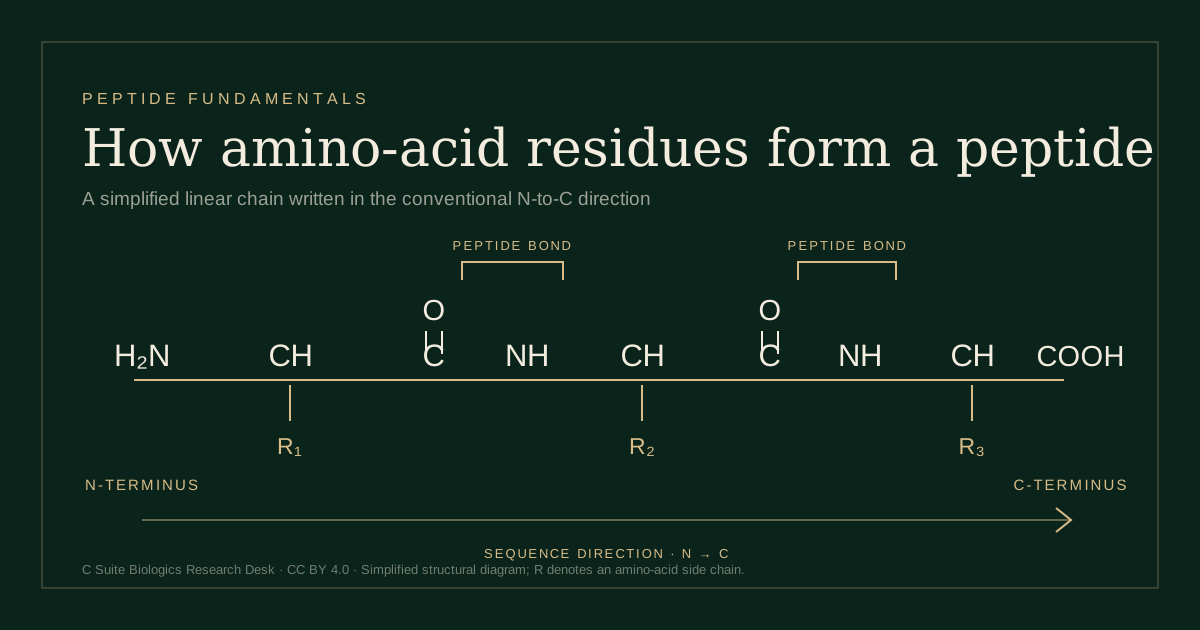
Peptide bonds connect a directional chain.
The simplified structure below follows a peptide from its N-terminus to its C-terminus. Each R group represents the side chain contributed by one amino-acid residue.
02 · Direction and notation
What is a peptide sequence? Direction and notation.
A peptide chain has two chemically distinct ends. The N-terminus carries the terminal amino group that is not acylated by a preceding residue; the C-terminus carries the terminal carboxyl group that is not forming the next peptide bond. Sequence notation is conventionally written from the N-terminus toward the C-terminus.
Researchers may represent residues with full names, three-letter abbreviations, or one-letter codes. Any terminal modification, side-chain modification, salt or counterion, disulfide connection, isotope label, or cyclization should be stated because it can change the material's molecular formula, mass, and behavior.
Reference table
The 20 standard amino-acid residues.
This reference connects the one-letter and three-letter sequence codes used in peptide notation with each residue's theoretical neutral monoisotopic mass and Kyte–Doolittle hydropathy index. Use the mass values as residue contributions after peptide-bond formation; an unmodified linear peptide with free termini also includes one terminal water molecule.
| 1-letter | 3-letter | Residue | Monoisotopic residue mass | Hydropathy |
|---|---|---|---|---|
| A | Ala | Alanine | 71.03711 Da | 1.8 |
| C | Cys | Cysteine | 103.00918 Da | 2.5 |
| D | Asp | Aspartic acid | 115.02694 Da | -3.5 |
| E | Glu | Glutamic acid | 129.04259 Da | -3.5 |
| F | Phe | Phenylalanine | 147.06841 Da | 2.8 |
| G | Gly | Glycine | 57.02146 Da | -0.4 |
| H | His | Histidine | 137.05891 Da | -3.2 |
| I | Ile | Isoleucine | 113.08406 Da | 4.5 |
| K | Lys | Lysine | 128.09496 Da | -3.9 |
| L | Leu | Leucine | 113.08406 Da | 3.8 |
| M | Met | Methionine | 131.04048 Da | 1.9 |
| N | Asn | Asparagine | 114.04293 Da | -3.5 |
| P | Pro | Proline | 97.05276 Da | -1.6 |
| Q | Gln | Glutamine | 128.05858 Da | -3.5 |
| R | Arg | Arginine | 156.10111 Da | -4.5 |
| S | Ser | Serine | 87.03203 Da | -0.8 |
| T | Thr | Threonine | 101.04768 Da | -0.7 |
| V | Val | Valine | 99.06841 Da | 4.2 |
| W | Trp | Tryptophan | 186.07931 Da | -0.9 |
| Y | Tyr | Tyrosine | 163.06333 Da | -1.3 |
Theoretical values are calculation references, not experimental measurements. Hydropathy is a sequence-scale descriptor and does not by itself establish solubility, conformation, membrane association, or behavior in a particular system. Continue to the peptide molecular-weight calculator for sequence-level mass, formula, pI, and GRAVY estimates.
Interactive peptide explainer
See a peptide sequence as a directional chain.
Enter standard one-letter amino-acid codes. The visualizer reads the sequence from its N-terminus to its C-terminus and shows the residue count and peptide-bond count.
Spaces, line breaks, hyphens, and FASTA headers are ignored. Unsupported or ambiguous residue codes are flagged instead of guessed.
- A1
- C2
- D3
- E4
- F5
- G6
- H7
- I8
- K9
Hover or focus a residue to read its name. Each connection between adjacent residues represents one peptide bond.
Naming boundary: residue count is useful but does not create a universal peptide-versus-protein cutoff. Folding, biological function, modifications, and scientific context also matter.
Calculate molecular weight, pI, charge and GRAVY →03 · Peptides and proteins
Length is useful, but it is not the whole distinction.
Short chains are generally called peptides; longer chains are often called polypeptides. A protein may contain one or more polypeptide chains folded into a functional three-dimensional structure. The commonly cited 50-amino-acid boundary is a practical convention, not a universal physical law.
The NCBI Bookshelf overview of peptide biochemistry provides a deeper treatment of peptide bonds, chain structure, and biological context.
Biological context
What do peptides do in biology?
There is no single function shared by every peptide. A peptide's sequence, three-dimensional structure, modifications, concentration, location, and molecular partners determine what it can do in a particular biological system. The category includes both short signaling molecules and larger peptide or polypeptide messengers.
Peptide hormones, neuropeptides, and polypeptide growth factors can carry information between cells by interacting with specific receptors.
Some peptides are secreted into circulation or local tissue environments and act as chemical messengers in regulated physiological systems.
Neuropeptides can be released by neurons and act as neurotransmitters or neuromodulators, sometimes alongside small-molecule transmitters.
Larger precursor polypeptides can be enzymatically cleaved into multiple shorter peptide products with distinct sequences and activities.
The NCBI overview of signaling molecules describes peptide hormones, neuropeptides, and growth factors as a diverse signaling group; its neuropeptide chapter explains how sequence and precursor processing contribute to neuropeptide activity. Those endogenous biological roles do not establish the identity, activity, safety, or suitability of a cataloged research material. Those questions require material-specific evidence and an appropriate experimental design.
04 · Structural types
“Peptide” covers more than one molecular form.
A sequence with distinct N- and C-termini and no backbone-closing covalent bond.
A peptide whose structure is closed through a backbone, side-chain, or other covalent connection.
A sequence carrying a stated terminal, side-chain, isotope, conjugate, or other chemical modification.
A mixture that must identify each intended component and cannot be represented by one sequence or mass alone.
These categories describe structure or composition, not quality. A linear, cyclic, modified, or blended material still requires lot-specific identity, quantity, and method context.
05 · Natural and synthetic peptides
Peptide sequences can be isolated, expressed, or synthesized.
Peptides occur naturally across biological systems. They can also be produced for research through methods such as recombinant expression or chemical synthesis. In Merrifield's foundational 1963 solid-phase synthesis paper, protected amino acids were added stepwise to a growing peptide chain attached to a solid resin. Modern workflows build on that principle with different protecting groups, coupling reagents, resins, cleavage conditions, and purification steps.
A synthetic material still needs to be identified and evaluated. A sequence name alone does not establish the contents, amount, purity, or suitability of a particular lot.
06 · Laboratory analysis
Different methods answer different peptide questions.
High-performance liquid chromatography can separate sample components and support a method-specific chromatographic purity estimate. Mass spectrometry measures ion mass-to-charge behavior and can provide evidence consistent with an expected molecular mass or sequence-derived target. The NIST peptide mass spectral library program illustrates how reference spectra support peptide identification workflows.
Neither method should be stretched beyond what it measured. HPLC area percentage does not by itself establish molecular identity or total peptide content. A mass match does not by itself establish chromatographic purity, measured quantity, sterility, endotoxin status, or suitability for an experiment. Read our HPLC vs LC-MS comparison and field-by-field COA guide for the analytical boundaries.
07 · Content versus purity
Peptide content and HPLC purity answer different questions.
How much principal peptide analyte is present by mass or amount under a suitable quantitative assignment?
What share of the included chromatographic detector response belongs to the main integrated peak under the stated method?
Does the analytical evidence support that the tested material is the intended molecular species?
What is the complete physical mass, including water, counterions, salts, residual solvents, or other constituents?
Those numbers can differ because a relative chromatographic response is not a direct mass-balance measurement. A peer-reviewed study of synthetic peptide reference standards describes using complementary techniques to establish identity, content, purity, and stability as separate attributes.
For a deeper method-specific explanation, read what 99% HPLC peptide purity means or use the peptide analysis method selector.
08 · Laboratory identity
What researchers review before use.
The ordered amino-acid residues and any stated modification.
Formula, theoretical molecular mass, and relevant salt or counterion information.
Lyophilized, solution, or another stated research format.
A lot identifier that connects the package to applicable analytical records.
The nominal quantity or concentration associated with the package.
The methods, results, dates, and limitations shown in supporting records.
09 · Sources
Primary references and further reading.
Peptide FAQ
Foundational questions.
What is a peptide?
A peptide is a chain of amino acids joined by peptide bonds. The National Human Genome Research Institute describes peptides as typically containing between two and 50 amino acids.
What are peptides made of?
Peptides are made of amino-acid residues arranged in a specific sequence. Adjacent residues are connected through covalent amide linkages commonly called peptide bonds.
What is a peptide sequence?
A peptide sequence is the ordered list of amino-acid residues in a peptide chain, conventionally written from the N-terminus to the C-terminus. It can be represented with full residue names, three-letter abbreviations, or one-letter codes; terminal and side-chain modifications should be stated separately.
What do peptides do?
Peptides do not have one universal function. Naturally occurring peptides can participate in cell signaling, hormonal communication, neurotransmission, precursor processing, and host-defense systems; a particular role depends on the peptide's sequence, structure, location, receptor or molecular target, and biological context.
How many amino acids are in a peptide?
The National Human Genome Research Institute uses a typical range of two to 50 amino acids. The boundary among peptide, polypeptide, and protein is a naming convention that can vary by scientific context rather than a universal physical cutoff.
What is a peptide bond?
A peptide bond is the covalent link formed between the carboxyl group of one amino acid and the amino group of another. Peptide bonds create the backbone of a peptide chain.
What is the difference between a peptide and a protein?
Peptides are generally shorter amino-acid chains. Longer chains are commonly called polypeptides, and one or more folded polypeptide chains may form a functional protein. Naming conventions vary by scientific context.
How are synthetic peptides made?
One established method is solid-phase peptide synthesis, in which a protected amino acid is attached to a solid support and additional residues are coupled stepwise to build the intended sequence before cleavage and purification.
How do laboratories analyze peptides?
Laboratories may use complementary methods such as HPLC for chromatographic separation and LC-MS or other mass-spectrometric methods for mass-to-charge evidence. Identity, chromatographic purity, measured quantity, and sterility are separate analytical questions.
What does peptide content mean?
Peptide content is a quantitative assignment of how much principal peptide analyte is present by mass or amount. It is not interchangeable with HPLC area-percent purity, total filled mass, molecular identity, or concentration unless those attributes were separately measured and reported.
What information identifies a research peptide?
Researchers commonly evaluate a peptide by its amino-acid sequence, molecular formula or mass, physical format, stated amount, lot identity, and supporting analytical records.